
Along with its rich cultural history and scenic beauty, Provence, France is known for its copious sunny days—a fitting attribute for a region that’s home to a massive scientific experiment aimed at emulating the power of the sun. As you might imagine, that’s a tall task. But it’s one that scientists and engineers from 35 countries around the world are collaboratively working on at ITER (International Thermonuclear Experimental Reactor).
Located in the south of France, amidst a spread of lush trees and mountainous background, the 180-hectare site of ITER is where one of humanity’s most complex projects is underway: creating nuclear fusion to help power our world. While nuclear fusion has its critics, others see it as a “holy grail,” an energy source that would fundamentally change the future of civilization.
In a short documentary by The Financial Times titled Fusion Power: Dream or Reality? journalist Simon Mundy explores the potential of fusion power, its origins and recent breakthroughs, as well as some of the many complex challenges that still remain.
The word “nuclear,” of course, brings up some not so cheerful connotations. The atomic bombs dropped on Japan during the final weeks of World World II delivered death and destruction on a scale like no other. But as Mundy makes clear at the outset of the film, nuclear fission—the process behind the atomic bomb—is different from fusion. While the former involves splitting atoms, the latter involves fusing them. There is no doubt, however, that fusion could also be used for highly destructive purposes.
But thankfully, nuclear fusion so far has a much less ethically thorny past than its cousin. In 1985, in fact, world leaders Ronald Regan and Mikhail Gorbachev spoke formally about using fusion for the good of humanity, not war. And roughly 25 years later, ITER was born: a paradigmatic example of massive intergovernmental collaboration focused on achieving a common goal.
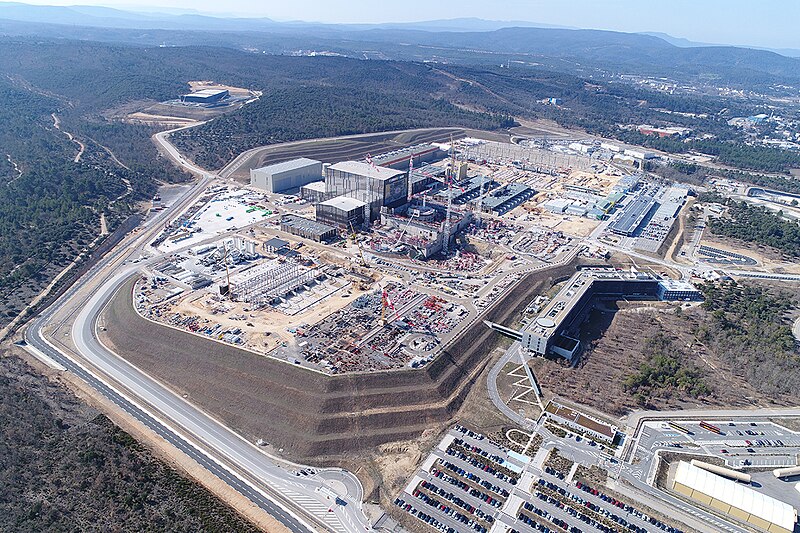
Image credit: Oak Ridge National Laboratory, Wikimedia Common
That goal of creating safe and abundant energy has come with challenges of all kinds. The Director-General of ITER, Pietro Barabaschi, describes in the film some of the many unique aspects of the project, including those that go beyond the scientific and technical. Managerial and organizational issues, for example, are at times a complicated business, unsurprisingly. Even within a single government entity things are often messy and tangled; one can only imagine the complexities of nearly three dozen countries working side by side. Yet since its inception in 2007, ITER has made steady gains in the unfathomably tricky world of fusion energy.
The specific device that ITER has been hard at work on is called a tokamak, a term that goes back to the 1950s when Soviet scientists built an experimental device called the T-1. (Twenty years prior to that physicists at the University of Cambridge were engaging in the first nuclear fusion experiments.) The tokamak is critical in the creation of nuclear fusion: it helps contain enormously hot plasma—as in 150 million degrees Celsius—using magnetic fields. That plasma is essential to the fusing of hydrogen atoms, which ultimately leads to the creation of enormous power.
Over the decades, there have been many stunning achievements in fusion energy. Just recently, in 2022, Lawrence Livermore National Laboratory made quite the splash: they achieved net energy gain. At least, they sort of did. The fusion reaction itself achieved net energy gain but “the system as a whole,” as Mundy puts it, “ate up far more energy than it gave out.” Nonetheless, it was a momentous feat. The then U.S. Secretary of Energy hailed the result as “one of the most impressive scientific feats of the 21st century.”
But scientists still have a long way to go before fusion energy is powering even a fraction of our world. Until net energy can be achieved (among other technical obstacles) fusion energy remains a thing of the future. It’s why some critics deem fusion energy as an absurdly expensive, always-around-the corner pipe dream—not to mention a distraction from other renewable sources of energy.
Some, however, adamantly disagree with that outlook.
Along with visiting ITER in France and exploring other government-funded initiatives, Mundy looks at the increasingly relevant rise of startups and private investment in the fusion energy domain.
Among the people he speaks with is David Kingham of Tokamak Energy, located in the UK. In Kingham’s mind—and many others—the introduction of well-funded startups could help accelerate the advancement of fusion energy, which still presents a plethora of daunting challenges. Kingham likens the growing presence of these startups to private space companies that have aided NASA over the past twenty or so years. Fusion energy, once “the preserve of the government laboratory,” he says, is now “becom[ing] accessible to privately funded innovators.”
One of those innovators is Commonwealth Fusion systems, in Boston. There are increasingly others, like Germany’s Proxima Fusion and Canada’s General Fusion. Potential investors in fusion energy have their plate full with weighing pros and cons—but for one bullish investor in the documentary, Phil Larochelle, this is a tremendously exciting time. When people ask him about his ardor for fusion energy, his response is to point them to the past when transistors first came out of Bell Labs. Just as it turned out with that invention, fusion energy could lead to “world-changing commercial technology.”
Whether or not that happens, only time will tell. But as Simon Mundy opines at the end of his short and helpful documentary, fusion power is “one of the most intriguing areas of technology to watch.”
 Spectatio
You must be logged in to post a comment.