
With its polished visual style and cast of insightful experts, this 2019 documentary offers viewers an engrossing, in-depth portrait of one of Venice’s all-time greats.
_________________________________
There are a lot of documentaries about artists out there. Many are decent enough, but they do tend to contain a fair bit of fluff and theatrics. Great artists, though there are exceptions, tend to live rather interesting lives. Gimmicky production styles and overly-caffeinated presenters don’t do anyone a favor.
Thankfully, Tintoretto: A Rebel in Venice, avoids so many of the irksome, melodramatic spectacles that have plagued more than a few documentaries. The subject of this finely-made film is Jacopo Robusti (better known as Tintoretto), the Renaissance painter who gave us works like The Miracle of the Slave and who lived during a particularly tumultuous time in one of the world’s greatest cultural cities.
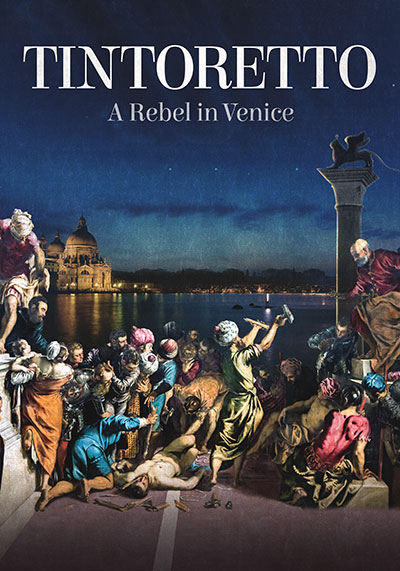
A Rebel in Venice is narrated by Helena Bonham Carter, who has since gone on to narrate at least three other documentaries. Her voice is perfect for the form. The cast of talking heads is refreshingly limited to a half dozen or so, each knowledgeable, earnest, and varied in their technical backgrounds.
The film opens 450 years ago with a scene that feels rather relatable given what Venice was experiencing: an epidemic. Though the denizens of the port city were no stranger to plagues, the one which started in 1575 was particularly brutal and unforgiving. Nearly one third of Venetians were dead when it came to an end roughly two years later.
The film’s two writers, Melania Gaia Mazzucco and Marco Panichella, use the event not just to tell us something about Venice but about Tintoretto the man. He could have left the city; he had the means. He not only stayed but painted Saint Roch Cures the Plague Victims, which exquisitely captured on canvas the plight of his fellow Venetians.
Tintoretto (1518-1594) is an interesting figure, and it’s fun to hear some of the contemporary stories told about him, both factual and apocryphal. One in the latter category is this: a teenaged Tintoretto was so bursting with undeniable talent that, after being taken to Titian (c. 1488-1576) to initiate an apprenticeship, the elder artist wanted nothing to do with him. True or not (or a bit of both) Titian and Tintoretto became intensely competitive rivals with no love lost between them.
The film’s directors, Giuseppe Domingo Romano and Pepsy Romanoff, opt for a wide-ranging look at Tintoretto’s life. The film’s academics, curators, and Tintoretto aficionados discuss everything from the painter’s upbringing and religious influences, to his business acumen, rivalries, artistic style, and the way in which he has influenced 20th-century movie directors.
One can also appreciate how the commentators speak with a level of detail and insight which goes beyond basic analyses or what you’d find with a simple online search. We learn, for example, that Tintoretto’s Saint Roch Cures the Plague Victims was “the first time that anyone had depicted the interior of a Venetian Lazzaretto in which we see men and women in a very charged and moving scene.” In another place, we learn how “X-ray fluorescence spectroscopy” has helped “to identify the components of the glaze” in some of Tintoretto’s paintings, which have led to a better understanding of Tintorett’s use of color, among other things.
Tintoretto, as talented as he was, attracted his share of critics. Veronese—Tinoretto’s younger rival—found many of his artistic techniques and strategies abhorrent. As the documentary discusses on several occasions, Tintoretto was known for his fast manner of painting and prolific output. (It’s not for nothing that his nickname was il Furioso.) Veronese felt that the manner in which he did this was less than noble. “Tintoretto was at times happy to copy other artists’ styles and to lower his fees and almost paint for free,” explains one commentator. Veronese worried these traits could be ruinous for the profession.
Of course, Tintoretto’s work has also garnered many lavish praises. The analyses of his paintings by the film’s commentators illuminate why, and it’s particularly interesting to hear them discuss the ways in which the styles of Tintoretto, Titian, and Veronese differed.
Lovers of art—or history, biography, or the creative process in general—will find much to enjoy in this thoughtfully-crafted film, one that’s full of gorgeous shots of Venice—a city that’s certainly produced its fair share of artistic greats.
 Spectatio
You must be logged in to post a comment.