
By the end of his career, Norman Rockwell had illustrated over three hundred covers for the Saturday Evening Post and provided millions of readers with reassuring images of American life. His paintings include such famous pieces as Doll and Doctor and Freedom from Want.
In the former, the adult health provider gently places his stethoscope over the heart of a young girl’s doll. In the latter, a close-knit family gathers around a table on Thanksgiving Day, ready to enjoy a scrumptious meal while taking pleasure in one another’s presence.
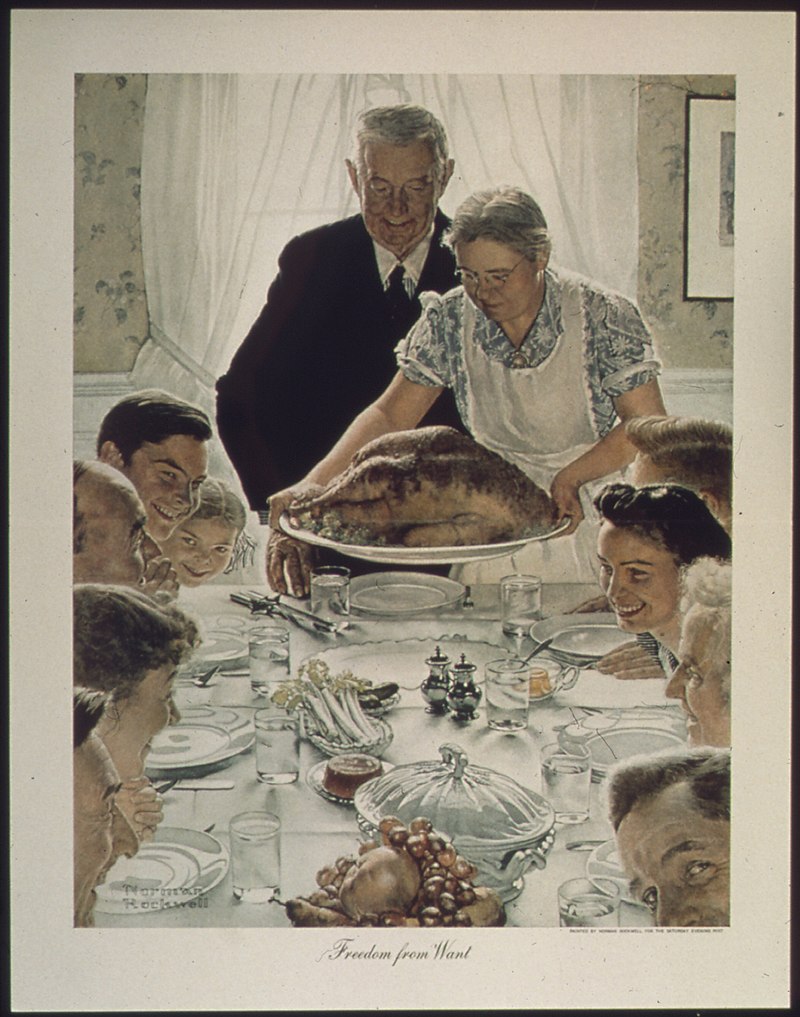
Want, published in the Saturday Evening Post, in 1943. (Wikimedia Commons)
Both then and now, Rockwell has been praised—and criticized—for his idealistic representations of American life. Where is the conflict, critics ask? Where on his canvases are the myriad tensions and hardships that so many Americans encountered, as they did during the Great Depression?
In short: nowhere.
By and large, Rockwell chose to paint scenes of tranquility and happiness. “I paint life as I would like it to be,” he said. It wasn’t until the 1960s, when Rockwell himself was in his 60s, that he became more socially and politically engaged and produced such paintings as The Problem We All Live With.
The upbeat nature of his paintings belie the muddiness of Norman Rockwell’s inner-life. A lifelong perfectionist, he could be intensely self-critical of his work. A glance at a painting from his past, and he could easily slip into a harangue about how he should have approached this or that element differently.
In the domestic sphere of his life, circumstances could also be prickly: there were broken marriages and fractured family relationships (though this documentary explores this aspect of his life relatively lightly. (We barely hear about his relationship with his parents, and we aren’t even informed that Rockwell had an older brother.) Rockwell undoubtedly succeeded in painting scenes of innocence and happiness, but the landscape of his own life was sometimes a rather muddied affair.
Thanks to an episode of PBS’ American Masters, these lesser-known sides of the prolific illustrator are brought out. In the end, they don’t detract from the merit’s of the great American painter; instead, they actually make Rockwell more real, more relatable, and more relevant.
Rockwell’s childhood was characterized by tremendous self-doubt. He was not athletic. He was not popular. He was not a good student (he was barely even a mediocre student). He was not blessed with particularly good looks. He once described his scrawny frame as “a bean pole without the beans.”
Nonetheless, he had faculty for art, and those skills were recognized by both teachers and his peers. After his time at Mamaroneck High School, he enrolled at the Arts Students League, in Manhattan, where he studied illustration. It was highly in vogue at the time; indeed, Rockwell’s first decades of life occurred during the Golden Age of Illustration.
The timing made sense. When Rockwell entered the League, in 1910, it would be some four decades before the TV made its pervasive entrance into the average American’s home. Common use of the camera was still getting underway.
Rockwell’s career in illustration took off with enviable speed; before he was even out of his teens he was the art editor of Boys’ Life. In one capacity or another, he provided them with illustrations for over a half century.
He would have a similarly long relationship with the magazine that brought him into the homes of millions of Americans, The Saturday Evening Post. His first cover appeared in 1916, his last in 1963. In the span of that time he created over three hundred covers and became a household name. One clip in the film shows Rockwell coming onto the stage of Ed Murrow’s show as the crowd heartily applauds. “I do want to thank you, on behalf of this country, for the wonderful, wonderful paintings you have furnished us with,” the host tells him.
Surprisingly, the process of creating his celebrated illustrations never became easier for Rockwell over time. Then again, he was meticulous in his process: he made extensive use of models (young and old), and, eventually, employed photography as well to help him craft his composition. Upon the completion of a painting, he might still decide to discard the final result and start over.
Rockwell’s son, Peter, relates how his father once spent 11 months on a single cover—and this was a seasoned artist who was in his studio every single day, holidays included. Rockwell was intensely devoted to his craft.
Whatever frustrations and misgivings Rockwell had about his art, his lifelong devotion to his craft, along with his vivid depictions of 20th-century America, earned him the Presidential Medal of Freedom, in 1977.
In one poignant scene in the documentary, a woman who had modeled for Rockwell many decades in the past relates a touching moment.
She happened to be in Stockbridge, MA, where the aged artist was living; she thought she’d say hi. Rockwell was old and in poor health, however, and it wasn’t clear that he would even remember her. Yet not only did he remember her, he immediately recognized her and embraced her with a warm hug.
 Spectatio
You must be logged in to post a comment.