
Barbara Graziosi’s compact and to-the-point book, titled simply Homer, offers a smoothly written and reader-friendly introduction to a host of tantalizing topics surrounding the Homeric epics. The Iliad and the Odyssey — millennia-old stories with a pulse that has never stopped beating — are imbued in our cultural imagination. But questions abound (and always have) about their authorship and nature of composition, the context in which their stories take place, what their larger-than-life characters meant to their earliest listeners (and to us now, as readers), and a bevy of other questions. One could spend a lifetime on any number of topics relating to these epics.
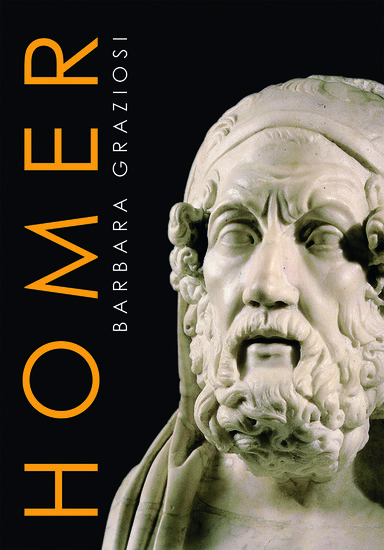
And some do. But for those of us who aren’t scholars or immersed in the scholarly literature, or who may be relatively new to the stories altogether, a succinct book laying out some of the issues involved in understanding, interpreting, and enjoying these perennial works, can be of great help. Graziosi’s Homer is such a book.
With tremendous economy, honed objectives, and a willingness to present information in a straightforward (and jargon-free) manner, Grazioso has achieved what seems like a relatively simple task — yet it is anything but. There exists a mass of research and material on the Iliad and the Odyssey, and inquisitive readers can find themselves sinking under a load of information. Educators, too, can find themselves in a similar predicament, wondering what to highlight and what to put aside.
Graziosi, formerly a Professor of Classics at Durham University and now at Princeton, breaks down her book into three very manageable, and enlightening, parts. The first part explores the Homeric Question and closely related topics — ancient reception, archaeology, and what the narrator of the poems might be able to tell us about who composed them. Parts 2 and 3 then dive into the Iliad and the Odyssey, respectively, supplying the reader with summaries of the plot while offering acute insights, perspectives, and various ways for readers to think about these two great works — one about wrath (mênis), the other about man (andra).
Depending on a reader’s prior knowledge of the material, the book will undoubtedly offer a greater or lesser amount of new information; but virtually all readers will close the book having learned something new.
Some topics addressed in the book can feel quite daunting — for example, the multiplicity of complex, intertwined issues regarding the composition of the Homeric epics. As one will quickly realize, insights into one area — e.g., the nature and purpose of epic formulae — can alter one’s opinions on the aesthetics of the works, as well as who may have composed them. Fascinating questions, to be sure, but more than capable of making one’s mind spin.
Potential readers of Graziosi’s Homer, however, can rest easy — for two reasons. One, Graziosi is an excellent communicator, capable of stripping down convoluted issues to their nuts and bolts. And two, scholars who are immersed in these complex, millennia-old questions, have come to a truly wide variety of positions. Consequently, there’s no need for one to feel that this or that particular position is the absolutely correct one. One of the satisfactions of the book is understanding just how much energetic conversation the Homeric epics have spawned over two and half millennia. Indeed, one of Graziosi’s aims with her book is “to show…how readers of Homer join a vast and diverse community of other readers.”
This community includes no less than Plato and Aristotle, Pope and Dryden, Vico and Wolf– each of whom had their own ideas about these epics. While Aristotle, for instance, believed them to showcase a singularly focused aim and idea, and to have been produced by a poetic genius, Giambattista Vico was inclined to believed they were the product of “collective authorship,” and that they contained elements of crudeness. Both were brilliant thinkers — along with the others mentioned — who sharply differed in their evaluations of the Iliad and the Odyssey.
Lest one think it’s only been philosophers, poets, and academicians who have engaged in, and contributed to, Homeric study, plenty of other types have as well. Graziosi draws our attention to the idealistic, pioneering, and brazen Heinrich Schliemann (far from a stuffy Oxford don) who made massive — and massively important — discoveries revealing historical sites of Troy and Mycenae. A contribution if there ever was one. Along with these great archaeological breakthroughs, other material evidence, e.g., Nestor’s cup, provide clues to the time and context in which the poems may have been composed. There are, however, no easy conclusions, and questions will always remain.
But the joy of experiencing these great poems need not be hindered by lingering questions; indeed the Iliad and the Odyssey (whenever they were composed, and by whomever) continue to speak volumes to us long after they were brought into the world.
In parts 2 and 3 of her book, Graziosi admirably manages to provide readers with summaries of each epic, while offering up nuggets of insight and well-articulated ideas about their respective themes, characters, narrative styles, and more.
In the figure of Achilles, parallels are made between the protagonist of Gilgamesh, who must also painfully grapple with his mortality. Death, specific and general, features heavily in both epics, and in the Iliad in particular, one can find modern resonances about death and loss. Graziosi points out some of the literature which has sought to highlight commonalities between psychological trauma of modern day veterans, with the psychological pain presented in the Iliad. Equally fascinating concerning the Iliad, is Graziosi’s discussion on perspective. Whoever composed the Iliad as we have it today, did so with an objective perspective that is rather astounding. From the manner in which the catalogues of ships and men are presented, to the layout of battle scenes, to the description of Achilles’ large yet intricate shield, the poet seems to have possessed an uncanny gift for visualization. If in fact the poet was blind, as more than a few have thought, such a talent seems especially poignant.
Graziosi offers an equally enthralling look at the Odyssey, whose afterlife has been as robust as perhaps any single work of literature. The story infatuated Dante, even though he couldn’t experience it in the original Greek (as Graziosi notes). Dante’s unique vision of Ulysses went on to influence countless artists in ways that, in some sense, make it difficult to think of Ulysses without at least partially viewing him through the lens of the medieval poet.
Then again, the Greek hero of the Odyssey is far too mutable to ever be pinned down — not just in our myriad re-imaginings of him, but in the epic itself. The wily Ulysses is characterized by several particular traits — not least polymechanos, “of many tricks.” As Graziosi astutely points out, however, “as his story develops, the words that characterize him shift in meaning, and begin to blend into one another.” Ulysses is three dimensional — and then some; he possesses so many nuanced layers of psychology, personality, and ways of adapting to the given situation, that he is forever his own person.
Graziosi’s book is a great read for those both new and familiar with the Homeric epics; its lucid, inviting, and a pleasure to read. Homer may have relatively modest aims, but its highly successful execution and inviting tone make it a book of considerable merit.
_____
Graziosi, Barbara. 2016. Homer. New York, NY: Oxford University Press.
 Spectatio
You must be logged in to post a comment.